Missed cohorts
A query may miss a disease-specific population when its distinguishing diagnosis detail has been lost.

OMOP AI-Readiness Audit · Leap of Faith Technologies
Most OMOP (Observational Medical Outcomes Partnership) common data model (CDM) repositories report 90–97% mapping coverage. That measures whether a concept was assigned, not whether it still says what the clinician meant. Our automated analysis finds where your mappings lose clinical detail and returns your clinical mapping assessment within one week of receiving one diagnosis term extract. No patient-level data is required. The full audit, including CDM quality checks and a results review with our team, is complete within 30 days and funded by Leap of Faith: no cost to your institution for Phase 1.
What the map reports
Specificity bottleneck
What fidelity preserves
Both code sets are required for the full representation of what the clinician documented.
Coverage vs. fidelity
Was a standard concept assigned?
What most OMOP dashboards report.
Does that concept still say what was true about the patient?
Clinical detail needed for the intended analysis.
In the standard mapping path shown here, the EHR maps a clinician's diagnosis term to ICD-10-CM, and the OMOP ETL maps that code to SNOMED. ICD-10-CM is a billing classification and may omit detail in the original term. A downstream model cannot reconstruct that detail from the broader code alone.
Why it matters for AI
When AI uses only the standardized OMOP layer, omitted clinical detail is unavailable to it.
A query may miss a disease-specific population when its distinguishing diagnosis detail has been lost.
A model can't stratify patients on a feature that was flattened away before training began.
Decision-support tools may use a broader diagnosis than the clinician documented.
The comparisons illustrate loss of detail in rare disease, oncology subtypes, lateralized conditions, chronic-disease variants and behavioral health.
The evidence
Two head-to-head comparisons, same design: a production academic medical center OMOP of roughly 4.7 million persons (Pilot Site 1), and a de-identified subset of 1,387 patients with hypertension run in full ATLAS detail. In both, two OMOP instances were built from the same source data and the same patient population; the only difference was the mapping path. The CDM, standard SNOMED concepts in condition_concept_id, CONCEPT_ANCESTOR, phenotype definitions, and OHDSI queries were identical.
In the standard instance, Ewing's sarcoma routes through ICD-10-CM C49.9, “malignant neoplasm of soft tissue, unspecified.” A query for it returns no one, even though the diagnosis was documented by name. In the enhanced instance, 28 patients appear.
Standard mapping retains breast laterality and prostate cancer identification, but enhanced mapping adds receptor status, metastatic sites and other distinctions shown below. Esophagus is the control: claims coding already preserves anatomic detail, so much of the representation is the same.
The comparison below shows two kinds of loss: criteria-level features that return no patients under standard mapping, and cancer populations that can be found but lack detail needed to split them into subgroups. Esophagus provides a control where claims coding is already specific. These are pilot research findings, not additional audit inputs or deliverables.
Standard vs Enhanced OMOP · Pilot Site 1, ~4M+ persons
Criteria-level features from the Marfan (Ghent) and hypermobile EDS diagnostic criteria, run as ATLAS concept sets. Standard mapping returns no one for any of them; the patients become findable before a syndrome diagnosis is ever recorded.
| Cancer | Standard can ask | Only Enhanced can ask |
|---|---|---|
| Breast | Laterality; unspecified site | ER status: ER+ ~10,000; ER− ~2,000 persons; bilateral disease; overlapping sites |
| Prostate | C61; genetic susceptibility | Metastatic site (bone 81, nodes, liver, lung, CNS); Gleason score; castration-sensitive; biochemical recurrence (29); active surveillance (10); germline BRCA2 (9), CHEK2, HOXB13 |
| Esophagus (control) | Anatomic third (C15–C15.9) | Primary vs recurrence vs metastatic; otherwise the same, because claims coding is already specific here |
Person counts are per source concept, not deduplicated cohorts. Pilot Site 1 ATLAS comparison, 2026.
A second comparison runs full ATLAS detail on a de-identified subset of 1,387 patients with hypertension: one set of concept sets, cohorts, characterizations, and pathway analyses against both CDMs. The base hypertension cohort returns the same 664 patients on both instances; the difference is what can be asked for.
The last row is the control: where ICD-10-CM already carries the detail in combination codes, nothing changes. Subtype and progression detail is what the standard path discards.
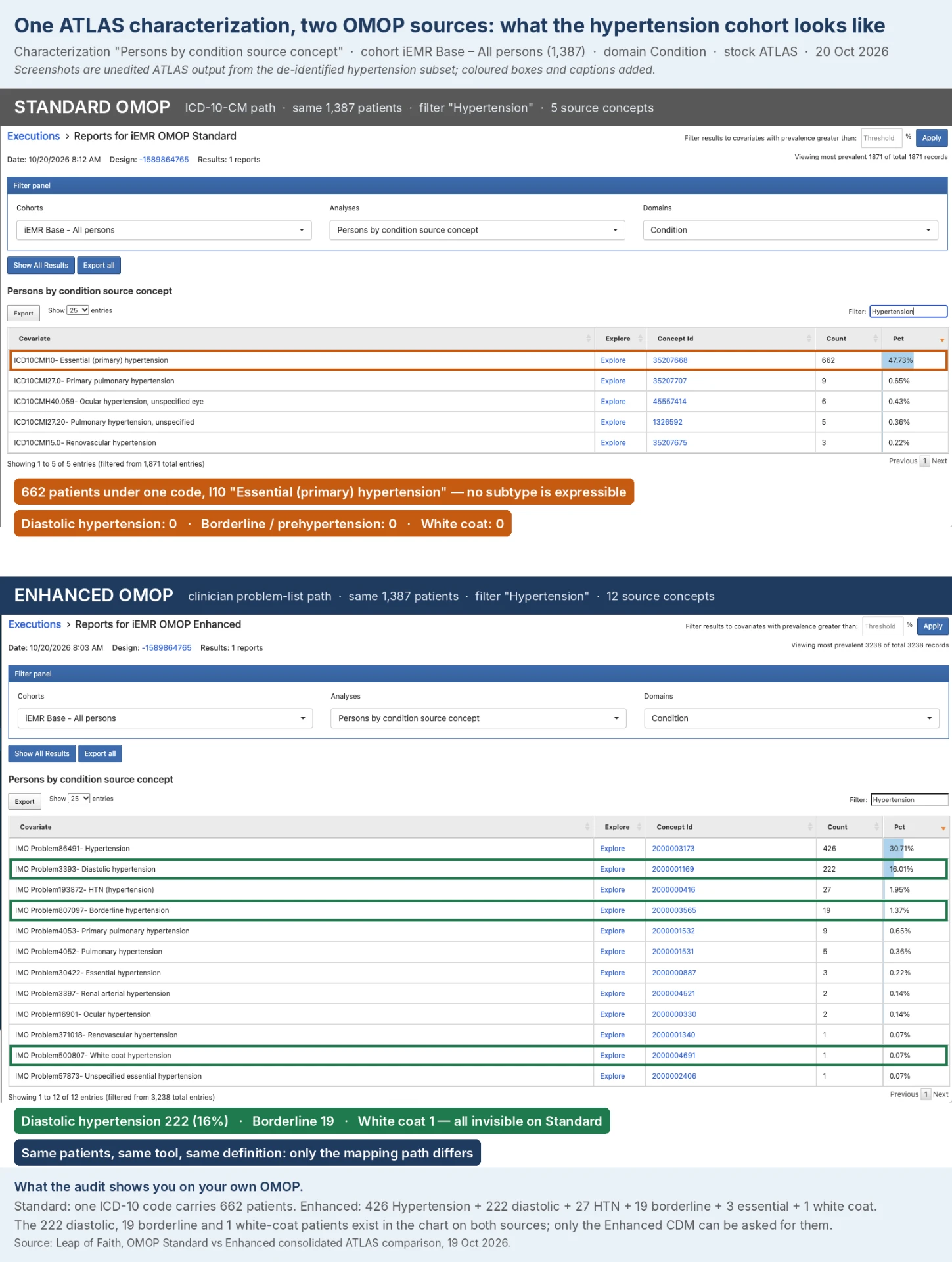
Standard vs Enhanced OMOP
Results from a small de-identified subset of 1,387 patients.
| What the clinician recorded | ICD-10 hop | Standard concept that results | What is lost | Patients affected |
|---|---|---|---|---|
| Diastolic hypertensionDiscarded | I10 Essential (primary) hypertension | Essential hypertension | The subtype. I10 has no diastolic, systolic or borderline distinction, so a diastolic-hypertension query returns no one. | 222 of 664 hypertensives (0 on Standard) |
| Renal impairment / renal insufficiencyDiscarded | N28.9 Disorder of kidney, unspecified | Kidney disease (not a descendant of Renal impairment) | The clinical meaning. The concept lands outside the branch a nephrology query looks in. | 111 on Enhanced vs 16 on Standard |
| Congestive heart failureDiscarded | I50.9 Heart failure, unspecified | Heart failure | The specific diagnosis. The concept sits above Congestive heart failure, so a CHF cohort misses almost everyone. | 98 on Enhanced vs 4 on Standard |
| Loss of appetiteInvented | R63.0 Anorexia | Anorexia nervosa | Accuracy in the other direction: the mapping asserts a psychiatric diagnosis the patient almost certainly does not have. | 62 patients mislabelled |
| Sleep apnea (unspecified)Invented | G47.30 Sleep apnea, unspecified | Central sleep apnea syndrome | The common form. Most of these patients have obstructive sleep apnea; the mapping names the rare one. | 65 patients mislabelled |
Source: Sholle et al., From Coverage to Fidelity: Enriching OMOP Repositories by Preserving Clinical Intent, manuscript under review, JAMIA Open, 2026, and the consolidated ATLAS comparison on the de-identified hypertension subset (internal report, October 2026). Presented as manuscript-stage evidence. Supporting literature: Weiskopf & Weng, JAMIA 2013 · Burrows et al., AMIA 2020 · Rijnbeek, Drug Safety 2014 · Hripcsak et al., JAMIA 2018
Read the full write-up →Four checks
The standard concept still carries what the source recorded, not a broader stand-in.
A specific population, like triple-negative breast cancer or Ewing sarcoma, can be pulled by diagnosis and actually returns those patients.
A combined diagnosis isn't silently split into pieces no single query can reassemble.
Clinical events remain linked over time rather than appearing only as isolated labels.
The audit
Two automated checks, clinical-intent mapping and CDM quality, followed by a review call with our team. Diagnostic only. It never writes to your CDM and never remediates. No patient-level data leaves your environment.
What your team commits: a 30-minute kickoff with your OMOP team, one CSV export in week 1, and read-only deployment of the audit package with our support.
Step 1 · Clinical Intent
Step 2 · CDM Quality
DQD tells you a CDM is structurally sound. It doesn't tell you whether your concepts preserve meaningful clinical distinctions. A database can pass DQD and still not be AI-ready, which is why Step 1 answers the question on this page.
Send the extract; get the report package within a week. Fastest for a first evaluation.
A licensed package in your environment validates the extract locally and submits only approved terminology fields. Results are identical.
The diagnosis term extract
One UTF-8 CSV covering the diagnosis dimension. At Epic sites this is a single query; we supply the reference query and a template.
30-day timeline
Kickoff: a 30-minute call with your OMOP lead and privacy office to agree permitted fields, retention, and access.
Your team produces and validates the diagnosis term extract.
Step 1 report delivered, within one week of receiving your extract.
Step 2 quality checks run read-only in your environment.
Joint review: readiness verdict and remediation path.
Data boundary
Because some institutions classify diagnosis descriptions as sensitive, we agree permitted fields, retention, and deletion with your privacy office before anything is submitted.
What you receive
Scope, component versions, AI-readiness score with its component measures, key findings, limitations, recommended review areas.
Every term, its current mapping, its classification, the SNOMED concepts it should reach, and estimated impact.
Current vs. recoverable coverage and patient reach by clinical area, so you can see which programs are most affected.
Every DQD and LOF rule, with severity and guidance.
Job metadata and versions for reproducibility.
The score includes its component measures and supporting row-level findings.
If results are unremarkable
If your instance already preserves intent well, the audit will say so, and you'll have a documented readiness baseline for your AI governance record, with no further commitment.
After the audit
Readiness verdict, quantified loss by clinical area, remediation path.
An enriched OMOP instance beside production. Your team runs cohort queries against both before any production change.
Two-pass ETL, stable concept IDs in the OHDSI-sanctioned 2B+ namespace, vocabulary refresh aligned with your Athena cycle, and no external API calls during daily ETL.
Preserved diagnosis detail supports cohort exploration and IPI retrieval. LIPI provides a longitudinal, problem-oriented view of each patient.
Each stage stands alone. The audit carries no obligation to pilot; the pilot carries no obligation to transition.
What stays fixed: CDM version · standard SNOMED in condition_concept_id · CONCEPT_ANCESTOR · existing phenotypes · ATLAS · OHDSI network participation
What AI-readiness unlocks
Why Leap of Faith
How do you capture what a clinician means, keep it intact across systems and decades, and make it computable? That question runs from early intelligent medical record research, through interface terminology and the patented longitudinal, concept-based record architecture, to today's Enhanced OMOP running in production at our pilot site.
The team offering this audit designed the interface-terminology and concept-based-management architecture it depends on.
FAQ