
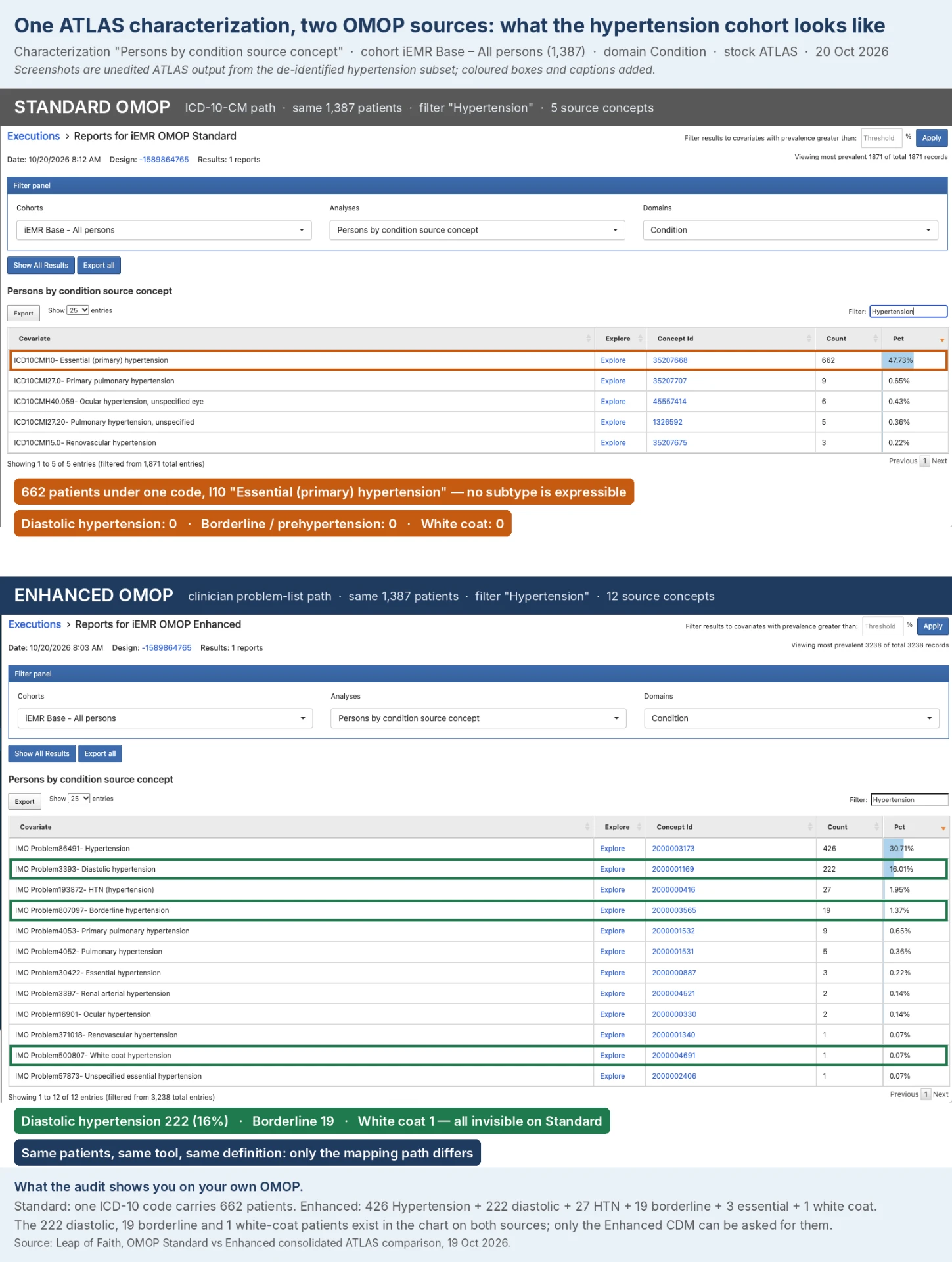
OMOP (Observational Medical Outcomes Partnership) common data model (CDM) repositories commonly report mapping coverage of 90–97%. Coverage measures the proportion of records assigned a standard concept.
Coverage does not measure fidelity: whether the assigned concept preserves the clinical detail documented in the source. That distinction matters when OMOP data is used for population queries or AI.
The mapping path through ICD-10 can discard diagnosis detail. A downstream model cannot reconstruct that detail from the broader code alone.
The two-hop bottleneck
At most EHR sites, clinicians document diagnoses in an interface terminology (usually IMO Health). In the typical OMOP pipeline, that term takes two hops before it reaches the analytical layer:
- The EHR vendor maps the clinician's term to ICD-10-CM.
- The OMOP ETL maps the ICD-10-CM code to SNOMED CT.
The problem is the middle step. ICD-10-CM is a billing classification built for reimbursement, and it is less precise than both the clinician's original term and SNOMED. The first hop is lossy by design, and the second hop has nothing to recover from. SNOMED can only be as specific as the ICD code handed to it.
So a repository can be fully mapped, pass every structural quality check, and still describe its patients more vaguely than their own clinicians did.
This isn't just our observation
The independent literature has been pointing in this direction for over a decade:
- Weiskopf & Weng (JAMIA, 2013) showed that EHR data quality is multidimensional and task-dependent, and that granularity was recognized as a quality trait with no established way to assess it. Passing conventional checks doesn't prove the data is semantically fit for a given research or AI task.
- Burrows, Razzaghi, Utidjian & Bailey (AMIA, 2020) compared a direct IMO Health-to-SNOMED path with the IMO Health-to-ICD-to-SNOMED path at CHOP/PEDSnet. The two routes landed on the same SNOMED concept only 24–27% of the time, and cumulative loss was 0.028% for the direct crosswalk versus 2.24% via ICD-10-CM. One example: via ICD, Duchenne muscular dystrophy broadens into a generic hereditary progressive muscular dystrophy, so DMD can no longer be distinguished.
- Rijnbeek (Drug Safety, 2014) argued that ETL information loss should be judged by its impact on study results, not concept counts.
- Hripcsak et al. (JAMIA, 2018) showed that vocabulary mapping choices for conditions measurably change phenotype cohort membership.
The common thread: mapping is an analytical decision with cohort consequences, not a neutral technical step.
Why this is specifically an AI problem
When an AI system uses only the standardized OMOP representation, detail omitted during mapping is unavailable to it.
Lost diagnosis detail can limit patient stratification, disease-specific queries and decision support. Evaluating the mapping path helps distinguish data limitations from model limitations.
Relevant examples include rare disease, oncologic subtypes, lateralized conditions, chronic-disease variants and behavioral health.
A head-to-head test on real data
To measure the effect directly, we worked with an academic medical center pilot site to build two OMOP instances on the same host, from the same Epic Clarity source data, for the same patient population.
- The standard instance used the usual IMO Health → ICD-10 → SNOMED path.
- The enhanced instance mapped interface terms directly to SNOMED CT where a mapping existed, falling back to ICD for legacy and external data.
Everything else was held constant. In both, condition_concept_id holds standard SNOMED concepts, CONCEPT_ANCESTOR is untouched, and existing phenotype definitions and federated OHDSI queries run identically. The only variable was the mapping path.
| Measure (same data, same patients) | Standard OMOP | Enhanced OMOP |
|---|---|---|
| Distinct standard SNOMED concepts in CONDITION_OCCURRENCE | 14,859 | 55,588 (3.74×) |
| Lung cancer: mean SNOMED concepts per patient | 1.74 | 4.12 |
| Lung cancer: shared patients gaining ≥1 additional concept | — | 74.9% |
| Lung cancer: patients retrievable only in this instance | — | 304 |
| Ewing's sarcoma identifiable as a distinct concept | Not recoverable | 28 patients |
Source: Sholle et al., "From Coverage to Fidelity: Enriching OMOP Repositories by Preserving Clinical Intent," manuscript under review at JAMIA Open, 2026. These are manuscript-stage results.
The patients who disappear
The 3.74× headline is less important than two specific findings.
Ewing's sarcoma. In the standard instance, it routes through ICD-10-CM C49.9, "malignant neoplasm of soft tissue, unspecified." Those patients show up only under generic soft-tissue neoplasm concepts, so a query for Ewing's sarcoma returns nobody, even though the diagnosis was documented by name. In the enhanced instance, the same source rows surface as a distinct SNOMED concept, and 28 patients become findable.
Lung cancer. 304 patients with lung cancer documented in the source cannot be found by a lung-cancer phenotype in the standard instance. For a trial-feasibility query, a quality measure, or an AI training set, they simply don't exist. Separately, 74.9% of the patients who were found gained additional concepts, meaning histology, extent, and complications became available to a model instead of a single generic label.
The lesson isn't that every broad mapping is wrong. It's that the level of abstraction determines whether a disease-specific cohort is computable at all, and in the standard pipeline nobody actually chooses that level.
Cohorts that can't be found at all
Criteria-level features from the Marfan (Ghent) and hypermobile EDS diagnostic criteria were run as ATLAS concept sets against both instances. Standard mapping returns no one for any of them, so an undiagnosed connective-tissue population cannot be found until a syndrome diagnosis is recorded.
| Clinical feature | Standard | Enhanced |
|---|---|---|
| Aortic root dilatation | 0 | 1,813 |
| Severe myopia | 0 | 1,448 |
| Joint laxity (including familial, EDS-type) | 0 | 411 |
| Mitral valve prolapse syndrome | 0 | 273 |
| Benign joint hypermobility | 0 | 254 |
Person counts are per source concept, not deduplicated cohorts. Pilot Site 1, ~4.7 million persons.
It happens in common cancers too
The comparison also found cohort loss in common cancers. Standard queries keep only broad detail. Some of the detail that defines a cohort is available only with Enhanced mapping.
| Cancer | Standard query detail | Available only with Enhanced mapping |
|---|---|---|
| Breast | Laterality; unspecified site | ER status (ER+ ~10,000; ER− ~2,000 persons); bilateral disease; overlapping sites |
| Prostate | C61; genetic susceptibility | Metastatic site (bone 81, nodes, liver, lung, CNS); Gleason score; castration-sensitive disease; biochemical recurrence (29); active surveillance (10); germline BRCA2 (9), CHEK2, HOXB13 |
| Esophagus (control) | Anatomic third (C15–C15.9) | Primary vs. recurrence vs. metastatic; otherwise the same |
A screen for ER-negative breast cancer, bone-metastatic prostate cancer, or men on active surveillance cannot be built from the standard instance. The patients are there. The distinction was lost before the query could see it.
Esophagus is the control. Claims coding is already specific there, so Enhanced mapping adds little beyond recurrence and metastatic status. That is what you would expect if the method is working.
And across all of medicine
This isn't an oncology quirk. Broken out by ICD-10 chapter, the enhanced path added distinct SNOMED granularity in every clinical area, with increases ranging from +172% to +972%:
| Clinical area | Standard | Enhanced | Increase |
|---|---|---|---|
| Neoplasms | 1,825 | 13,693 | +650% |
| Endocrine & metabolic | 953 | 6,312 | +562% |
| Mental & behavioral | 916 | 4,682 | +411% |
| Circulatory | 1,438 | 9,202 | +540% |
| Musculoskeletal | 5,129 | 20,446 | +299% |
| Symptoms & signs | 592 | 6,344 | +972% |
| External causes | 669 | 1,820 | +172% |
Selected chapters. Counts are distinct concepts within each area and are not additive across areas; administrative Z-codes excluded.
The added specificity is a property of the mapping method, and it reproduces across chronic disease, behavioral health, and symptom domains that population-health and AI programs depend on.
What "AI-ready" means, concretely
We think four properties are worth checking on any OMOP instance:
- Intent preserved. The standard concept still carries what the source recorded, not a broader stand-in.
- Cohorts retrievable. A specific population, such as ER-negative breast cancer or Ewing sarcoma, can be pulled by diagnosis and actually returns those patients.
- Post-coordination intact. A combined diagnosis isn't silently split into pieces no single query can reassemble.
- Journey preserved. The patient is a longitudinal sequence, not a bag of point-in-time labels.
Notice that none of these require changing the OMOP standard. In the pilot, the CDM version, standard SNOMED concepts in condition_concept_id, CONCEPT_ANCESTOR, existing phenotypes, ATLAS, and OHDSI network participation all stayed the same. The fix lives in the ETL, not the repository.
Measuring it on your own data
Because the effect depends on each site's source terminology and pipeline, the only way to know how much your instance loses is to measure it. We've built a 30-day AI-Readiness Audit for exactly that. It is diagnostic only: it never writes to your CDM, and no patient-level data leaves your environment.
Step 1, Clinical Intent, uses a single diagnosis term extract: diagnosis IDs and titles, IMO Health term IDs where available, current ICD-10 mappings, and aggregate patient and visit counts. The analysis is automated and returns within one week of receipt. Each term is checked against reference crosswalks and classified as fully captured, missing a secondary code, missing the primary code, or unrelated. Terms that can't be resolved are reported as explicitly unscored rather than quietly classified. The result is an AI-readiness score reported alongside its component measures, so every number traces back to row-level findings.
Step 2, CDM Quality, runs OHDSI's Data Quality Dashboard plus additional checks read-only inside your environment. DQD tells you a CDM is structurally sound for OHDSI use; it doesn't tell you whether the chosen concepts preserve clinically meaningful distinctions. A database can pass DQD and still not be ready for AI, which is why Step 1 is the one that answers the question.
If your instance already preserves intent well, the audit will say so, and you'll have a documented baseline for your AI governance record.
Where this leads
Preserving diagnosis detail supports more specific cohort queries and the Intelligent Phenotype Index (IPI) as a retrieval source. LIPI organizes an individual patient's longitudinal record around their problems, as described in our LIPI-KG research series.
These uses require checking whether the standardized data retains the clinical distinctions recorded at the source.
Interested in running the AI-Readiness Audit on your OMOP instance? Contact Leap of Faith Technologies, Libertyville, Illinois.
References: Weiskopf & Weng, JAMIA 2013 · Burrows, Razzaghi, Utidjian & Bailey, AMIA 2020 · Rijnbeek, Drug Safety 2014 · Hripcsak et al., JAMIA 2018 · Sholle et al., From Coverage to Fidelity, manuscript under review, JAMIA Open 2026.