Intent preserved
The standard concept still carries what the source recorded.

Population analytics platform
IPI (Intelligent Phenotype Index) is LOFT's population analytics platform. It enhances the OMOP (Observational Medical Outcomes Partnership) common data model (CDM) repositories so diagnoses keep the clinical intent clinicians documented, and cohorts built on them can distinguish more specific patient populations.
Prostate cancer · ICD-10 C61
In a common OMOP mapping path, the clinician's diagnosis term passes through ICD-10 before reaching SNOMED. This can discard subtype and other clinical detail. A high mapping-coverage score does not show whether that detail survived, and downstream analysis cannot reconstruct it from the broader code alone.
IMO Health interface terminology is loaded into the OHDSI OMOP stack, consumed the same way licensed vocabularies are today.
A two-pass mapping keeps the clinician's documented concept, routes it to the right OMOP domain, and falls back to ICD only when needed.
Same CDM, same ATLAS, same phenotype queries and network federation.
The standard concept still carries what the source recorded.
Diagnosis detail supports queries for specific populations rather than broader categories.
Combined diagnoses are not silently split apart.
Clinical events remain linked across the patient record over time.
Evidence In a pilot comparing two OMOP instances built from the same source data, the enhanced instance produced about 3.7 times as many distinct SNOMED condition concepts, and recovered rare diagnoses the standard pipeline could not distinguish.
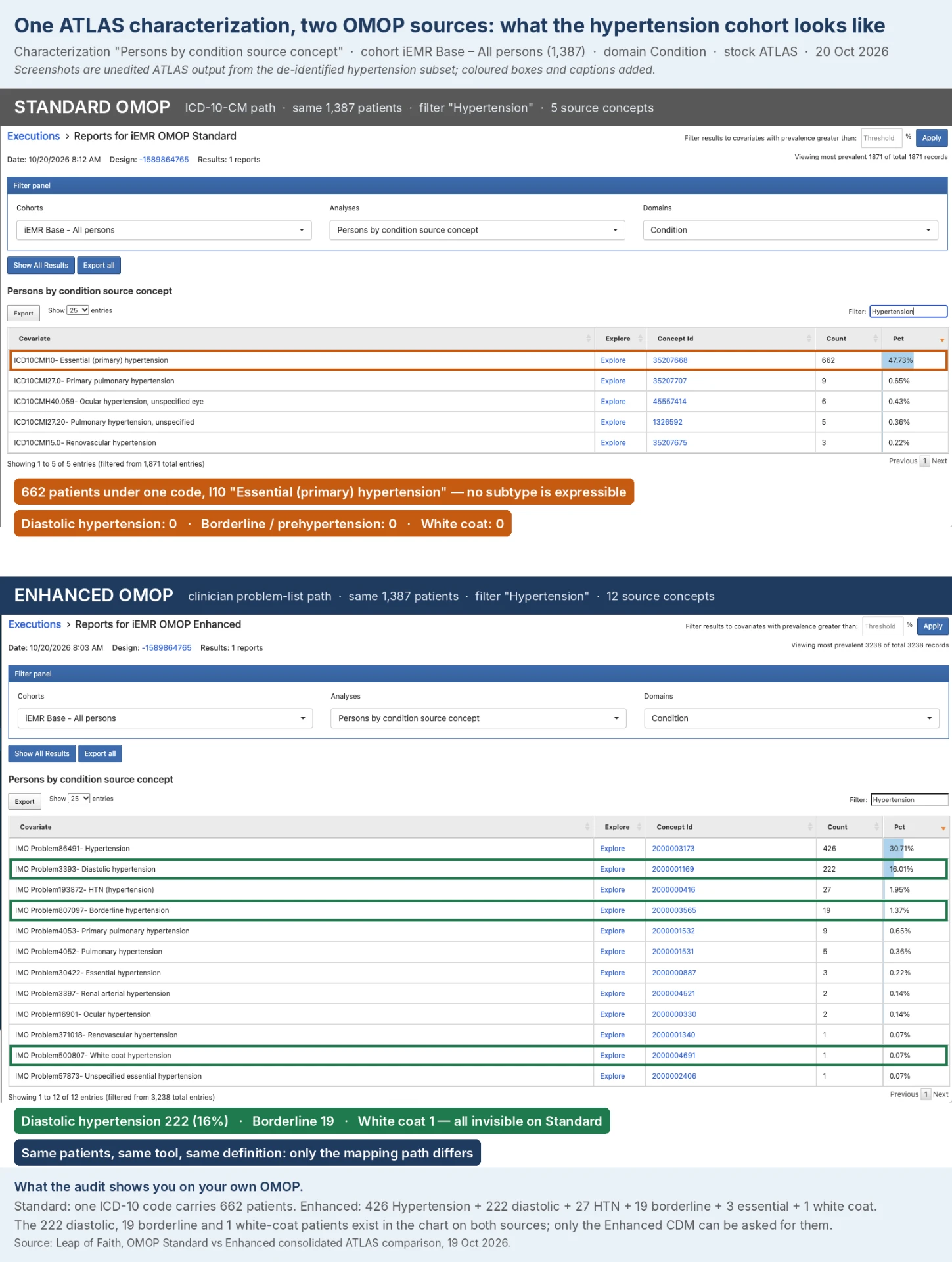
Standard vs Enhanced OMOP
Results from a small de-identified subset of 1,387 patients.
| What the clinician recorded | ICD-10 hop | Standard concept that results | What is lost | Patients affected |
|---|---|---|---|---|
| Diastolic hypertensionDiscarded | I10 Essential (primary) hypertension | Essential hypertension | The subtype. I10 has no diastolic, systolic or borderline distinction, so a diastolic-hypertension query returns no one. | 222 of 664 hypertensives (0 on Standard) |
| Renal impairment / renal insufficiencyDiscarded | N28.9 Disorder of kidney, unspecified | Kidney disease (not a descendant of Renal impairment) | The clinical meaning. The concept lands outside the branch a nephrology query looks in. | 111 on Enhanced vs 16 on Standard |
| Congestive heart failureDiscarded | I50.9 Heart failure, unspecified | Heart failure | The specific diagnosis. The concept sits above Congestive heart failure, so a CHF cohort misses almost everyone. | 98 on Enhanced vs 4 on Standard |
| Loss of appetiteInvented | R63.0 Anorexia | Anorexia nervosa | Accuracy in the other direction: the mapping asserts a psychiatric diagnosis the patient almost certainly does not have. | 62 patients mislabelled |
| Sleep apnea (unspecified)Invented | G47.30 Sleep apnea, unspecified | Central sleep apnea syndrome | The common form. Most of these patients have obstructive sleep apnea; the mapping names the rare one. | 65 patients mislabelled |